
Insights

Insights and perspectives


Project mode and product mode: beyond common misconceptions

Do you think project mode is obsolete? WRONG!

Product mode has established itself as a benchmark in IT transformation models by building on agile methodologies. Promoted for its “disruptive” virtues, product mode is seen as the ideal organizational model that every modern IT department should strive for. By contrast, project mode is often considered outdated and ill-suited to the transformation challenges companies face.

This opposition is reductive.

At Valthena, we believe that project mode and product mode are not opposed, quite the contrary. Project and Product complement each other, each contributing to the operational excellence of the IT department in different contexts.
User Volatility Calls for a Product-Centric Model

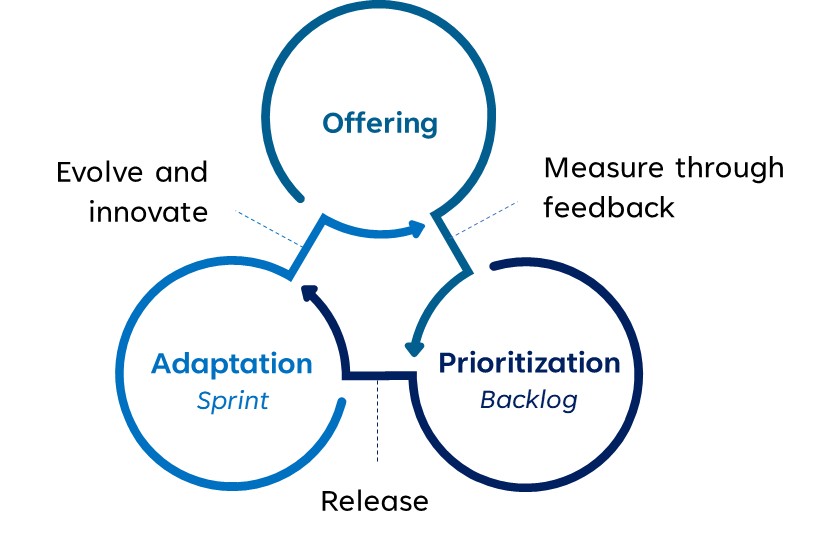
In a product-centric model, user behavior is the foundation of the organization: the way users actually adopt and interact with the product shapes the approach and drives decision-making.

A product originates from a use case identified as valuable for a specific target audience. Its value proposition is continuously refined throughout its lifecycle. As user behavior evolves and the business environment shifts, that value is reassessed and redefined.

To keep pace with changing usage patterns and emerging needs, a capacity-based model is put in place, ensuring the product can evolve continuously.

Teams are structured to support the entire lifecycle, with strengthened capabilities and seamless end-to-end collaboration — from development to operations and support.

Development priorities are driven by user behavior and expectations. And as users increasingly adopt the product, new needs naturally emerge.

The backlog (a dynamic roadmap) is a structuring planning tool between users and product teams: it enables the identification, description, and prioritization of expected use cases.

Combined with short release cycles (sprints), the backlog enables continuous realignment around customer satisfaction.

In other words, the user is no longer just a target audience: user behavior becomes a key indicator of product usage, adoption, and satisfaction — ensuring that the product’s evolution stays aligned with expectations.

The sprint serves as a regular checkpoint, where user needs meet the proposed solution. Sprint cycles can adapt beyond standard cadences to match evolving usage patterns, enabling faster innovation. Iteration after iteration, the product is progressively shaped in line with the major phases of its lifecycle.

For example, the launch of a B2C customer portal is highly dependent on user adoption. In this context, a product-centric operating model is particularly well suited, enabling rapid response times and continuous integration of user feedback.

However, multiplying experiments without a clear framework carries a risk: that of the “eternal prototype,” where teams and resources are continuously mobilized without ever stabilizing the value delivered.

The product model also shows its limits when the expected outcome is clearly defined and does not depend on evolving user behavior. In such cases, the challenge is not to iterate endlessly, but to precisely frame the requirement and ensure disciplined execution focused on operational excellence.

Artificially maintaining a logic of continuous iteration can then generate unnecessary complexity and delay the achievement of the intended outcome.

Project Mode Ensures Quality Regardless of Usage — or Prepares the Ground for Product Mode

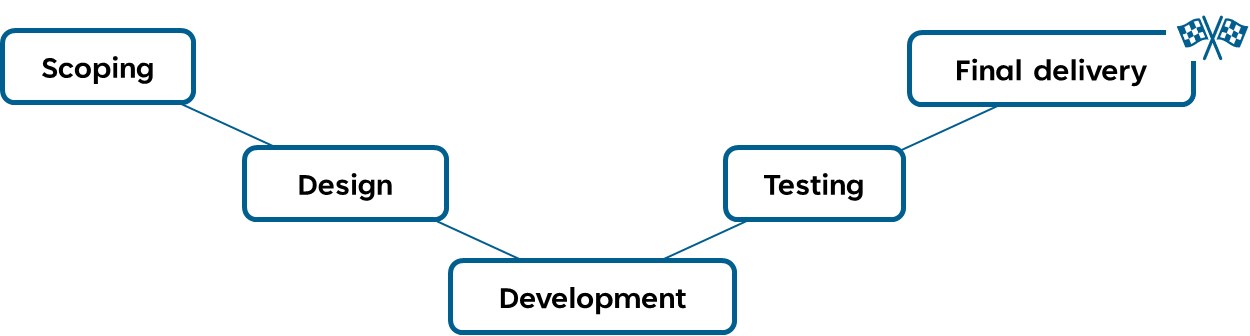
In project mode, the objective is to deliver a clearly defined requirement, within a controlled budget and timeline. It prioritizes reliability and robustness, which is why it is often favored for structural IT transformations.

This model is perfectly suited to needs that are not usage-dependent or that precede end-user adoption, such as infrastructure upgrades, regulatory compliance initiatives, or the scoping of a prototype, for example.

Project mode organizes and frames efforts from the outset to achieve a concrete and operational result upon delivery — or before a potential transition to product mode, once the initial requirement is clearly defined.

For example, a WAN network migration illustrates the value of project mode. Controlling costs, timelines, and quality from the design phase is critical. Once the network is deployed, the success of the migration depends on the absence of user-reported issues.

In practice, we observe that IT initiatives are carried out in a hybrid manner, blending project and product approaches.

The project is not opposed to the product; it simply addresses a different logic of value creation.

In Conclusion: Project Mode and Product Mode Are Complementary Approaches

  • Project mode follows a “fit-for-purpose” approach (Project Management Institute, Project Management Embraces the Fit‑for‑Purpose Approach, 2024) grounded in operational excellence. It addresses defined and stable needs, whether in infrastructure, processes, or compliance. When well executed, a project ensures reliability, risk control, and performance.
  • Product mode, on the other hand, operates in a quality-driven approach in the face of variable usage: it evolves according to user feedback, optimizing value and experience throughout the lifecycle, within a secure environment.
  • Project mode and product mode complement each other: one provides a solid foundation, while the other leverages innovation to serve operational needs. Combining these two modes within an IT department requires careful attention to maximize operational performance.

About the author

  • Letoya SAMAR Senior Consultant

Follow us on Linkedin