Insights and perspectives
Artificial Intelligence: What Potential for the Finance Function in Banking?

How can artificial intelligence transform the finance function in banking?
To answer this question, we analysed 9 domains of the finance function, covering nearly 80 processes and 600 tasks, each task drawing on a set of elementary skills to be carried out properly. We then mapped this framework against the ability of artificial intelligence to perform each of these elementary skills.
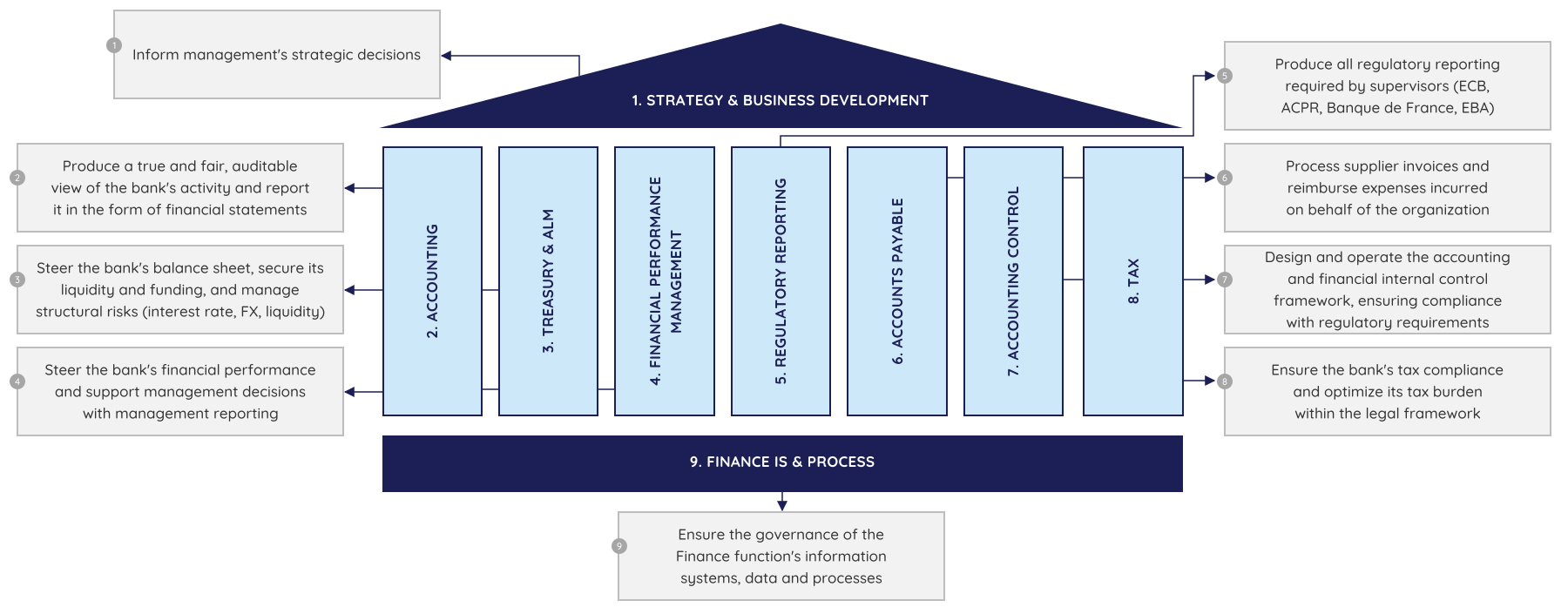
The findings point to a finance function better equipped to fulfil its core missions.
In short, we identify real opportunities for AI to add value, strengthening the finance function’s analysis and forecasting capabilities and enabling it to operate on shorter cycles and with new depth.
- From processing to analysis →greater command of the numbers
Orchestrating algorithmic and AI tools will eventually make it possible to automate almost all processing, freeing up capacity for investigating exceptions, continuous improvement and analysis.
- Shorter cycles →more responsive steering
Deploying AI-enabled tools shortens production cycles and makes simulations easier to build. In practice, information, whether actual (past) or projected (future, simulations), is available sooner, enabling far better steering and forecasting.
- From delayed to real time →lower risk
Incidents, anomalies and alerts are detected immediately rather than after the fact. Diagnostics can therefore begin much sooner after events occur, and corrective actions can be taken very quickly, limiting the impact.
The analysis is based on our business frameworks, combined with our AI expertise.
| Domain | Typical share of FTE | Processes | Tasks |
|---|---|---|---|
| Strategy & Business Development | 3% | 4 | 28 |
| Accounting | 18% | 17 | 101 |
| Treasury & ALM | 9% | 16 | 100 |
| Financial Performance Management | 20% | 7 | 41 |
| Regulatory Reporting | 12% | 9 | 103 |
| Accounts Payable | 16% | 4 | 26 |
| Accounting Control | 10% | 7 | 50 |
| Tax | 7% | 10 | 63 |
| Finance IS & Process | 5% | 4 | 47 |
| Total | 100% | 78 | 559 |
Opportunities by domain. At a first level of reading, by domain, the potential for AI adoption varies: the largest opportunities lie in Financial Performance Management and Regulatory Reporting, which combine large headcounts with high potential, followed by Accounts Payable and Accounting, which mobilize many FTEs and retain significant potential for AI adoption.
But measuring the impact of AI at the level of individual tasks makes it possible to identify opportunities more precisely, and to single out the processes with the highest potential for AI adoption. The analysis also shows that addressing the top 14 or 15 processes captures 50% of the tasks with high AI potential. These are the processes where the transformation should start, to secure tangible benefits.
Moreover, the opportunities differ in nature but exist across every type of activity in the finance function.
Transactional activities: the opportunities lie mainly in automation and pre-analysis, reducing the data-handling workload and freeing up time for analysis and control.
- Transaction automation
- Stronger controls
- Pre-analysis of exceptions
Areas of expertise: here, the contribution of artificial intelligence will be far more targeted, but opportunities exist in file preparation, scenario development and what we call structured archiving: the ability to fully document decisions and the reasoning behind them, in particular to inform subsequent decisions, whether AI-assisted or not.
- File preparation
- Scenario development
- Structured archiving
Reporting, analysis and forecasting: this is where artificial intelligence can make the greatest contribution within the finance function. Automation, the ability to run many more analysis scenarios at a depth that was not possible until now, and fast iteration and simulation when events affect the business: the potential is significant.
- Reporting automation
- Stronger analysis (depth, accuracy, speed of delivery)
- Multiple forecasting scenarios
Finally, different technologies need to be deployed depending on the nature of the elementary skills involved in each process, as the following diagram shows:
Swipe the diagram sideways to explore it →
In summary: a best practice is to start with proven use cases, in order to capture business value early and build momentum for the transformation. The table below identifies the “Top 14” processes with the highest potential for AI adoption, the technologies to deploy and the gains that can be expected.
| Top 14 opportunities | Technologies to deploy | Potential gains | ||||||||||
|---|---|---|---|---|---|---|---|---|---|---|---|---|
| ID | Process | What AI brings | Generative AI | Machine Learning | Agentic orchestration | Quantitative modeling | Deterministic automation | 0–5% | 5–10% | 10–15% | >15% | |
| 1 | Produce Commercial Performance Reporting | Reporting available as soon as data is validated, reconciled with accounting and commented for each network | Generative AI | Deterministic automation | Potential gain >15% | |||||||
| 2 | Reconcile Accounts Payable | Supplier suspense items handled on an ongoing basis, with balances justified at the time of matching | Generative AI | Machine Learning | Agentic orchestration | Deterministic automation | Potential gain >15% | |||||
| 3 | Produce Monthly P&L Report | Results published with commentary, and variances against the estimate tracked at each close | Generative AI | Deterministic automation | Potential gain >15% | |||||||
| 4 | Manage Accounts Payable Inquiries | Routine requests handled without interrupting teams, and recurring causes fixed at the source | Generative AI | Agentic orchestration | Deterministic automation | Potential gain >15% | ||||||
| 5 | Process Accounts Payable (Invoices…) | Invoices captured automatically, with duplicates and suspicious bank details detected before payment | Generative AI | Agentic orchestration | Deterministic automation | Potential gain 10–15% | ||||||
| 6 | Prepare Budget and Forecast | More iterations within the same budget cycle, with trade-offs documented at each version | Generative AI | Agentic orchestration | Quantitative modeling | Deterministic automation | Potential gain 10–15% | |||||
| 7 | Account for Financial Instruments | Faster classification of new instruments, with automated and documented processing | Generative AI | Quantitative modeling | Deterministic automation | Potential gain 10–15% | ||||||
| 8 | Produce Business Line and Entity Profitability | Profitability analyses by business line and entity, commented and reconciled with the accounting before release | Generative AI | Deterministic automation | Potential gain 10–15% | |||||||
| 9 | Produce Regulatory Reporting | Regulatory filings reconciled with source data as soon as they are generated, and traceable back to the original data | Generative AI | Deterministic automation | Potential gain 10–15% | |||||||
| 10 | Perform Permanent Supervision Controls | Controls that produce their own evidence, with effort refocused on handling anomalies | Generative AI | Deterministic automation | Potential gain 10–15% | |||||||
| 11 | Account Reconciliation and Substantiation | Suspense items cleared faster by identifying their root causes | Generative AI | Machine Learning | Agentic orchestration | Deterministic automation | Potential gain 10–15% | |||||
| 12 | Account for Operations | Anomalies detected and analyzed across all flows, so each day closes without carrying over discrepancies | Generative AI | Machine Learning | Agentic orchestration | Deterministic automation | Potential gain 10–15% | |||||
| 13 | Control Regulatory Reporting Quality | Submissions made reliable before they are sent to the supervisor, with anomalies qualified and documented | Generative AI | Machine Learning | Agentic orchestration | Deterministic automation | Potential gain 5–10% | |||||
| 14 | Provide Adhoc Reports | Standard reports delivered within hours, with the analyst stepping in only to review | Generative AI | Agentic orchestration | Deterministic automation | Potential gain 5–10% | ||||||