Insights and perspectives
Building an ETF Platform: Challenges, Models, and Pathways
The European ETF market is entering a phase of sustained acceleration, driven by broader investor adoption and a steady pace of new launches.
In this context, building an ETF platform has become a strategic lever for asset managers seeking to combine product innovation, operational efficiency, and multi‑channel distribution.
This article offers an overview of the market, outlines the specificities of launching and managing ETFs, examines white‑label solutions, details the organizational impacts of an in‑house platform, and sketches a pragmatic roadmap to move from strategy to execution.
Market overview: Supporting a structural growth trajectory
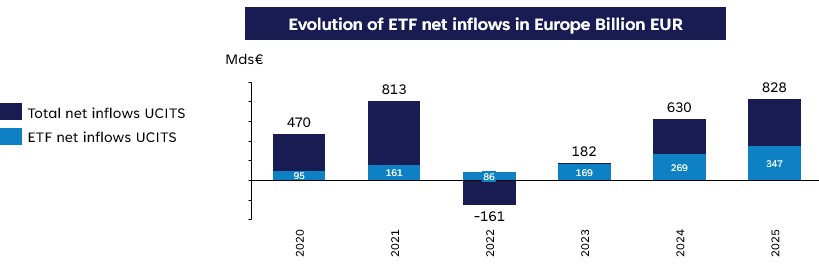
The share of ETFs within UCITS assets has been rising for several years, while their contribution to net flows has emerged as a key driver of industry inflows. Notably, ETFs accounted for 43% of UCITS net inflows in 2025, underscoring their central role in allocation strategies.
The frequency of press announcements regarding new launches and partnerships is the most tangible indicator of this momentum.
The French market, which remains highly concentrated and dominated by a handful of incumbent players, is nevertheless seeing the emergence of additional issuers—often supported by external partners—reflecting the segment’s openness to more differentiated, notably active, strategies.
This diversification broadens use cases across retail and wealth management, as well as institutional mandates and life insurance.
Launching an ETF : Validate market demand, Position the product and De-risk execution
From a commercial perspective, the success of an ETF starts with precisely identyfing the target market, aligning distribution channels, and selecting the right strategy. Several options are available
- Replicate a proven strategy, accepting the risk of cannibalizing existing assets. This required ensuring distribution channels are complementary to mitigate that underlying risk
- Launch a new strategy that will need to find its market
In all cases, a seed investor will lend the credibility to the launch and help catalyse the initial secondary-market flows.
ETF operations: Choose a white‑label provider or Build an internal platform
Operationally, the ETF ecosystem demands disciplined day‑to‑day execution: maintaining contractual and operational relationships with Authorized Participants (creation/redemption), ensuring liquidity provision by Market Makers, publishing portfolio composition files (PCF) on a set cadence, monitoring the iNAV, and handling incidents and corporate actions.
Unlike a traditional UCITS fund, an ETF adds a capital‑markets layer that connects portfolio management to price formation on exchange, with heightened requirements for responsiveness and transparency.
Two strategic operating paths for issuers:
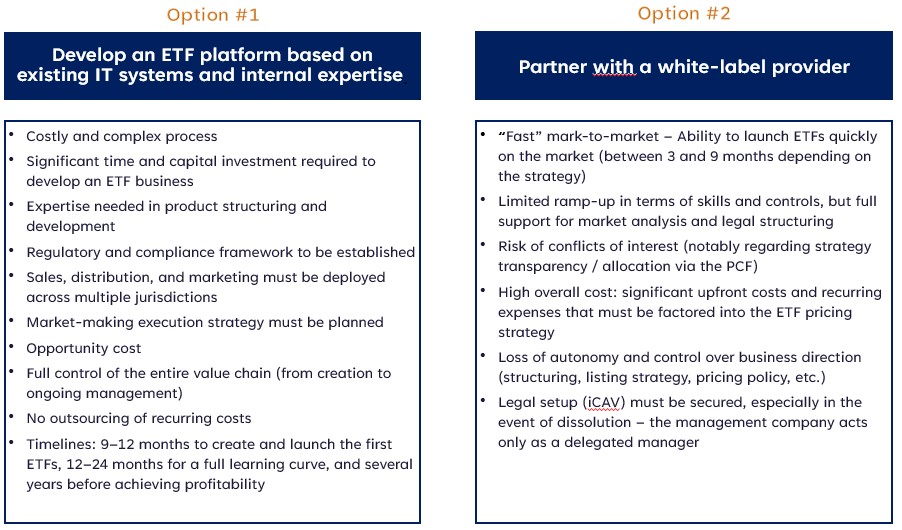
- Build an internal platform leveraging existing IT systems and in‑house capabilities.
- Rely on a white‑label provider to outsource a meaningful portion of the value chain end‑to‑end.
White‑label market offerings: Accelerating time to market
Leading white‑label providers offer end‑to‑end services, including market benchmarking, product co‑design, legal structuring (ICAV/Manco), capital‑markets integration with APs/Market Makers, distribution of PCF and iNAV, multi‑exchange listings, and marketing support.
This model shortens the learning curve, mutualizes fixed costs, and de‑risks execution. However, it entails recurring fees and requires strengthened governance to preserve strategic direction and ensure product transparency.
Building an internal platform: Align roles, Develop capabilities, and Upgrade systems
Standing up an internal ETF platform requires precise delineation of roles and responsibilities across portfolio management, capital‑markets, and middle‑office teams.
The capital‑markets team manages relationships with APs/MMs, designs and validates baskets (including custom baskets for active ETFs), anticipates flows, and minimizes the impact of creations/redemptions on tracking error.
The ETF middle office runs dedicated processes: standardizing and disseminating the PCF, validating AP orders (in‑kind/cash), settlement and reconciliations, and oversight of NAV and iNAV.
The organization should also rely on a marketing/legal function experienced in the ETF market to accelerate time to market and secure multi‑jurisdictional compliance.
From a systems perspective, connectivity to APs/MMs, exchanges, and CSDs is critical. The PMS/OMS must include an index replication engine, a primary‑market module, cash management for creations/redemptions, and real‑time monitoring capabilities (spreads, volumes, anomalies).
Internalization offers full control and, over time, economies of scale—at the cost of a significant upfront investment and longer lead times for the first launch.
Implementation roadmap: Define a pragmatic, time‑boxed plan
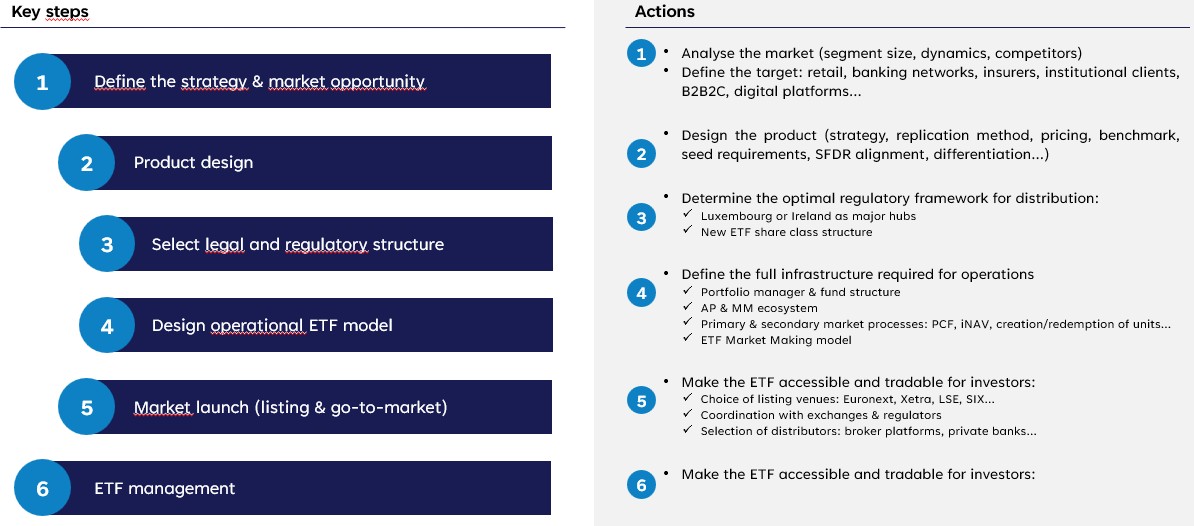
Execution should follow a phased trajectory with clearly sequenced milestones.
Implementation timelines can vary significantly depending on the chosen model: from 4 to 6 months with a white‑label provider, to 6 to 12 months to stand up an internal platform.
Expect 12 to 24 months for the organization’s full learning curve, and several years—supported by sufficient volume—before achieving a complete break‑even.
Conclusion: Seize the opportunity, Master execution
The rapid growth of ETFs creates a strategic window for asset managers able to combine a clear client value proposition, deep command of the market ecosystem, and governance tailored to listed products. Whether via an internal platform or a white‑label approach, the challenge is to orchestrate a demanding ecosystem and embed industrial‑grade routines into day‑to‑day operations.
Valthena supports this shift by bringing market expertise, defining your target operating model, and mobilizing partners to accelerate time to market and ensure high‑quality execution.
About the author
-
![]() Nicolas CHAPIS Associé
Nicolas CHAPIS AssociéRiche de 25 années d’expérience professionnelle dans le conseil, Nicolas met son expertise dans la gestion de programmes de transformation complexe à dominante stratégique, règlementaire ou opérationnelle au service des acteurs du wealth management, de la gestion d’actifs et de la banque de financement et d’investissement.
contact@valthena.com